
Emergency Evacuation Diagrams
We provide professionally designed emergency evacuation diagrams that comply with Australian Standard AS 3745 – Planning for Emergencies in Facilities.Emergency Evacuation Diagrams
AS 3745 Compliant Evacuation Plans for Workplaces and Buildings
Emergency evacuation diagrams are an essential part of workplace safety and emergency preparedness. Clear and accurate evacuation diagrams help occupants quickly understand how to safely exit a building during an emergency such as a fire, gas leak, or other hazard.
We provide professionally designed emergency evacuation diagrams that comply with Australian Standard AS 3745 – Planning for Emergencies in Facilities. Our diagrams are clear, easy to read, and tailored specifically to your building layout to help ensure occupants can evacuate safely.
Whether you manage an office, warehouse, apartment building, school, or commercial facility, professionally prepared evacuation diagrams are a critical component of your emergency planning.
Contact us today to organise compliant evacuation diagrams for your facility.
What Is an Emergency Evacuation Diagram?
An emergency evacuation diagram is a visual map of a building that shows occupants how to exit safely during an emergency. These diagrams are typically displayed throughout a building in visible locations so occupants can quickly identify evacuation routes and emergency equipment.
Evacuation diagrams usually include:
- Emergency exits and escape routes
- Fire extinguishers and hose reels
- Fire alarm call points
- Emergency assembly areas
- First aid locations
- Emergency equipment
- A “You Are Here” marker showing the viewer’s current location
- Emergency contact details
The purpose of these diagrams is to help people understand the safest and fastest way to exit a building during an emergency.
In Australia, evacuation diagrams are generally created as part of a building’s Emergency Plan under AS 3745.
Who Needs Evacuation Diagrams?
Emergency evacuation diagrams are required in many workplaces and facilities to support emergency planning and occupant safety.
Buildings that commonly require evacuation diagrams include:
- Commercial offices
- Warehouses and industrial facilities
- Apartment buildings and residential complexes
- Hotels and accommodation facilities
- Retail shops and shopping centres
- Schools and childcare centres
- Hospitals and medical facilities
- Government buildings
- Manufacturing facilities
- Any building with an emergency plan should have clearly displayed evacuation diagrams to guide occupants during an emergency.
Displaying evacuation diagrams in key locations helps ensure everyone in the building understands evacuation routes before an emergency occurs.
AS 3745 Compliant Evacuation Diagrams
Our evacuation diagrams are designed to align with the requirements of Australian Standard AS 3745 – Planning for Emergencies in Facilities.
This standard provides guidance on emergency planning and evacuation procedures for buildings and workplaces.
Evacuation diagrams designed under AS 3745 typically include:
- Clearly marked exits and evacuation routes
- Emergency equipment locations
- Assembly areas
- Easy-to-read layouts and text
Clear and compliant evacuation diagrams help support emergency planning, staff training, and safe evacuation procedures.
Professional Evacuation Diagram Design
We create custom evacuation diagrams designed specifically for your building or facility.
Every building layout is different, so evacuation diagrams should be prepared to accurately reflect the layout, exits, and safety equipment in your facility.
Our evacuation diagram services include:
- Review of building floor plans or layouts
- Identification of evacuation routes and exits
- Placement of emergency symbols and safety equipment
- Clear “You Are Here” indicators
- Assembly area identification
- Multiple diagrams for large facilities
- Digital files ready for printing and display
Our diagrams are designed to be clear, simple to understand, and easy for occupants to follow during an emergency.
Where Evacuation Diagrams Should Be Installed
Evacuation diagrams should be displayed in prominent locations where occupants can easily see them.
Common locations for evacuation diagrams include:
- Near building exits
- In hallways and corridors
- Near stairwells and lifts
- At building entrances and reception areas
- In accommodation rooms in hotels or apartments
- Near meeting rooms and shared spaces
- At key decision points within the building
Proper placement of evacuation diagrams ensures people can quickly locate evacuation routes during an emergency.
Our Evacuation Diagram Process
We make the process simple and efficient.
1. Site Visit
We visit your site to evaluate your floor layout, measure and sketch up plans.
2. Review of Emergency Features
We identify exits, evacuation paths, emergency equipment, and assembly areas.
3. Evacuation Diagram Design
We create clear and compliant evacuation diagrams tailored to your facility.
4. Delivery of Completed Diagrams
You receive high-quality diagrams ready for installation. We provide your choice of either laminated or framed diagrams for your premises.
For larger buildings or multi-level facilities, multiple diagrams will be produced to ensure coverage throughout the building.
Why Evacuation Diagrams Are Important
Emergency evacuation diagrams play an important role in workplace safety and emergency preparedness.
Key benefits include:
- Helping occupants quickly locate exits during emergencies
- Improving building safety awareness
- Supporting emergency planning and evacuation procedures
- Assisting staff and visitors who are unfamiliar with the building
- Supporting compliance with emergency planning standards
In an emergency, clear instructions and simple visual guidance can significantly improve evacuation outcomes.
Frequently Asked Questions
Are evacuation diagrams required in Australia?
Many workplaces and facilities use evacuation diagrams as part of their emergency planning under AS 3745 – Planning for Emergencies in Facilities. Diagrams help occupants understand evacuation routes and emergency equipment locations.
How often should evacuation diagrams be updated?
Evacuation diagrams are valid for 5 years or until any renovations or changes to the business or building structure have been implemented.
What information is shown on an evacuation diagram?
Typical evacuation diagrams include exits, evacuation routes, emergency equipment, assembly areas, and a “You Are Here” marker to help occupants orient themselves.
Need Emergency Evacuation Diagrams for Your Building?
If your workplace or facility requires clear and professional evacuation diagrams, we can help.
We provide custom evacuation diagram design for workplaces, commercial buildings, and residential facilities.
Contact us today to discuss your requirements and organise compliant evacuation diagrams for your building.
Emergency Evacuation Diagram Example
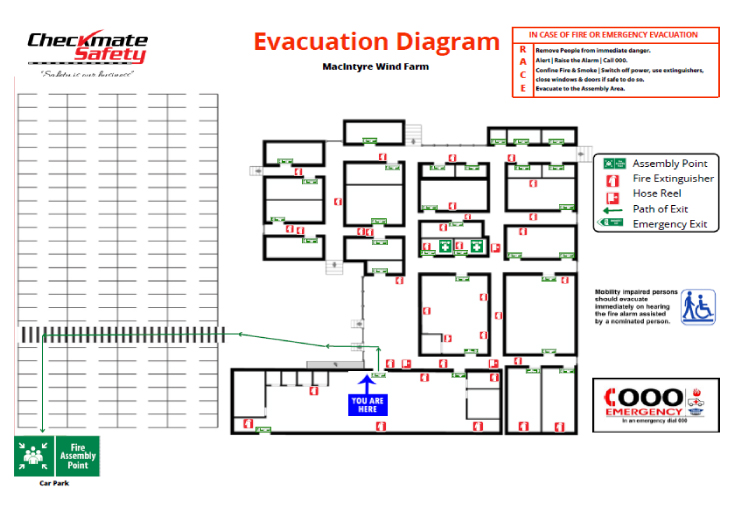
Emergency Evacuation Diagrams
We provide custom evacuation diagram design for workplaces, commercial buildings, and residential facilities.
Contact us today to discuss your requirements and organise compliant evacuation diagrams for your building.
